
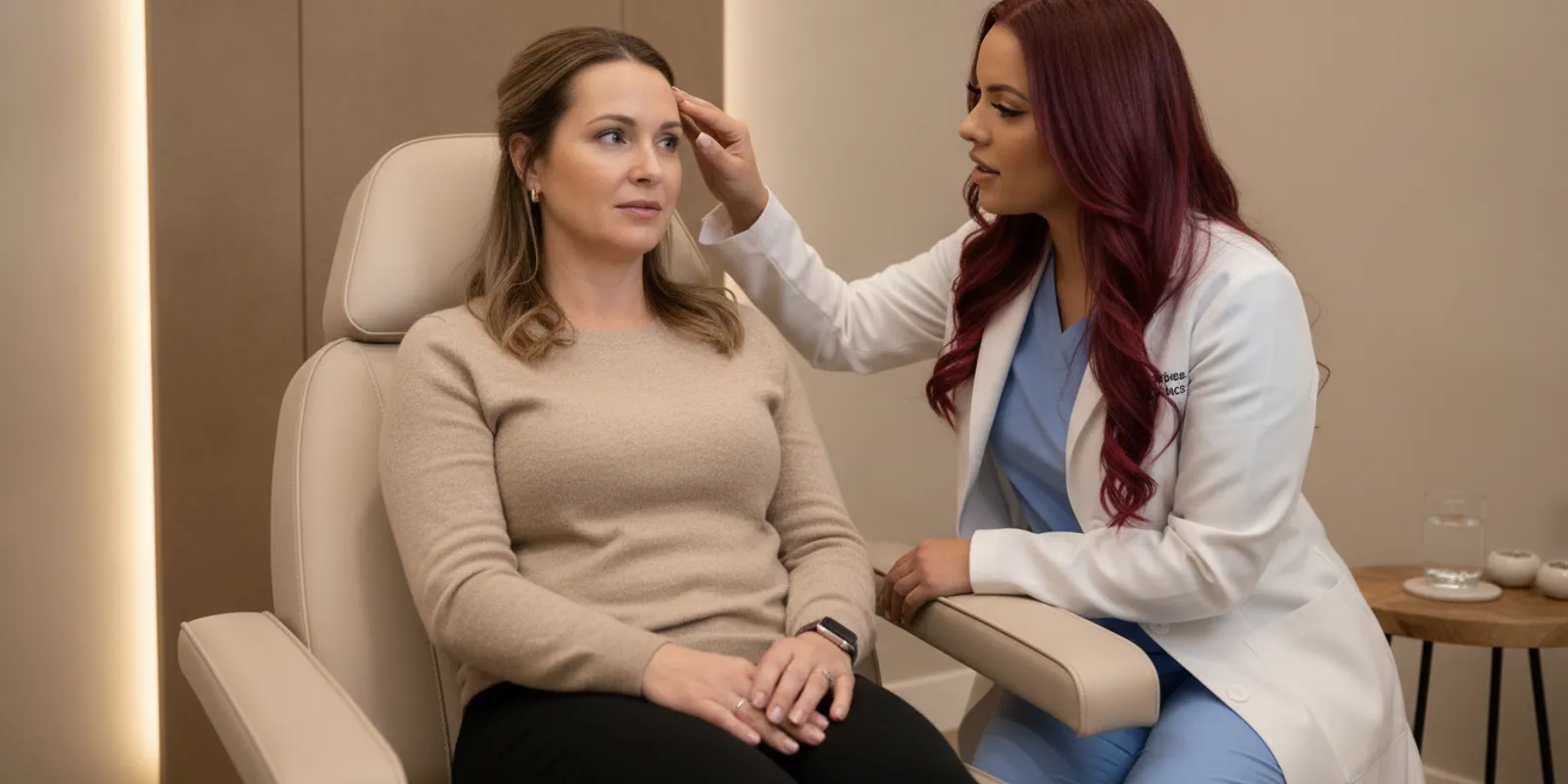
If you are wondering how many units of Botox for forehead lines might be appropriate, the honest answer is that there is no single number that fits everyone. The amount depends on how your forehead moves, your anatomy, your goals, and how a qualified provider plans treatment in relation to nearby muscles.
Schedule a personalized consultation
How many units of Botox for forehead lines can one person need?
A forehead treatment plan is based on an individual assessment, not a standard dose selected from a chart. People can have different muscle strength, brow position, movement patterns, and preferences about how much movement to retain. Even two people who notice similar horizontal lines may need different plans.
That is why an online estimate cannot confirm what is appropriate for you. A number discussed in general educational material is not a prescription or a personal recommendation. Your provider needs to assess your face in motion, review your medical history, and discuss the result you want before considering treatment.
Botox is a prescription treatment. For general information about prescription medicine safety and the role of the U.S. Food and Drug Administration, see the FDA website. A consultation with a qualified medical professional is the right place to discuss whether treatment is appropriate for you.
How many units of Botox for forehead lines depend on anatomy?
The forehead is part of a connected system of facial muscles. The muscles that lift the brows work in relation to muscles between the brows that draw them inward or down. A provider considers those interactions rather than treating a line as an isolated mark. This helps make the plan specific to your facial movement and desired balance.
Several factors may shape the discussion:
- Muscle movement: How strongly and widely the forehead contracts can affect the amount and placement a provider considers.
- Brow position: The resting position of your brows and how you use your forehead to lift them are part of the overall assessment.
- Facial balance: Nearby areas may be considered together so the plan accounts for how different muscles work in relation to each other.
- Your preferences: Some people want to soften visible lines while retaining expressive movement. Others may have different priorities to discuss.
- Medical history and prior treatment: Previous experiences, health conditions, medicines, and past reactions are relevant details for the clinician to review.
These are discussion points, not a formula for calculating your dose at home. A provider should explain the reasoning behind a proposed plan and give you time to ask questions before deciding.
It can help to separate the concern you see from the treatment you assume you need. For example, a line that appears when you raise your brows is different from a line that remains visible when your face is relaxed. A clinician can discuss what may be realistic for either concern, but an assessment does not guarantee that every line will disappear. Skin texture, age-related changes, and individual response can also influence what you notice.
Bring a clear description of what you would like to change and what you want to preserve. If you value a visibly expressive forehead, say so. If you are mainly concerned about a particular line, point it out in ordinary lighting rather than relying on a filtered photo. Reference images can help explain your preferences, but they cannot serve as a promise that your result will match someone else’s face.
Before treatment, share relevant health information and ask whether anything in your history affects candidacy or timing. Mention prior injectable treatments and any previous side effects. Do not withhold information because a treatment seems routine. The clinician needs a complete picture to decide whether to proceed, adjust the plan, or recommend that you wait or seek other medical guidance.
What does a provider assess before recommending a plan?
A thoughtful assessment looks at your face both at rest and while you make expressions. The provider may ask you to raise your brows, frown, or relax your forehead. This helps show which muscles are active and how movement changes the lines you see.
The conversation should also cover what concerns you most. Are you focused on lines that appear only when you raise your brows, or do you notice lines when your face is relaxed? What level of movement feels natural to you? Have you had injectable treatments before, and how did you feel about the outcome? Clear answers help the provider understand your priorities without promising a particular result.
Your full facial assessment matters because forehead treatment can affect brow movement and position. The clinician should consider your baseline anatomy and discuss possible trade-offs. If a suggested approach is unclear, ask how the plan relates to your own expressions and whether there are alternatives, including choosing not to treat.
To learn more about the treatment category, review the injectable services overview. For forehead Botox planning, the treatment details should be discussed with a provider who can evaluate your face and goals in person.
Which factors change the amount considered?
The table below summarizes why one person’s plan may differ from another’s. It is a guide to the questions a clinician considers, not a dosing calculator.
| Assessment factor | Why it matters |
|---|---|
| Forehead muscle activity | Movement strength and pattern help the provider understand how your forehead functions. |
| Brow position and lift | The relationship between the forehead and brows is part of planning for facial balance. |
| Lines at rest or during expression | Your concern and when the lines appear help define the goal of a consultation. |
| Desired movement | Preferences about expression and softness should be discussed before a plan is proposed. |
| Medical history and prior treatment | Health details and previous responses can affect candidacy and clinical decision-making. |
How should you compare a general estimate with a consultation?
General estimates can sound precise, but they leave out the details that make a treatment plan personal. They may not say whether the number refers to the forehead alone or a broader treatment area. They may also leave out the person’s anatomy, treatment history, or desired degree of movement. For those reasons, avoid treating an estimate you find online as a target to request or a promise of what you will receive.
At a consultation, ask the provider to explain the proposed treatment area and the factors behind the plan. You can also ask what movement may remain, what potential side effects to consider, when a follow-up discussion may be appropriate, and what to do if you have concerns after treatment. The goal is not to arrive with a predetermined number. It is to understand the options and decide whether the plan fits your needs.
A useful conversation often follows a simple sequence:
- Describe your concern. Explain when you notice the lines and what you would like to change, using your own words.
- Review your history. Share prior treatment details, relevant health conditions, medicines, allergies, and any reaction you have experienced.
- Hear the assessment. Ask what the provider observed about your movement and how that observation shapes the options discussed.
- Confirm the plan and next steps. Make sure you understand the proposed area, cost, risks, aftercare guidance, and how to follow up with questions.
You do not have to decide during the first conversation. If you are unsure, ask for the explanation in simpler terms or request time to think. A provider should be able to distinguish what is known from what cannot be predicted for an individual. If the plan does not address your stated priorities, raise that before agreeing to treatment. Clear communication is part of informed decision-making, not an extra step.
Care is also a relationship. You should feel comfortable sharing your concerns and asking for a plain-language explanation. To learn about the people and approach behind the practice, visit the Soul Glow Medspa team page, and read patient reviews as one part of your own research.
What should you know about cost and follow-up?
Also consider the quality of the explanation, not just the number proposed. A careful discussion should connect the plan to what the provider observed, acknowledge what treatment may not change, and make room for your questions. You should know who will perform the treatment, what medical oversight applies, and how to reach the practice if you have a concern afterward. If you cannot get clear answers, pause and ask for more information before making a decision.
Forehead lines can be influenced by more than muscle activity. A consultation can clarify whether your main concern is expression-related movement, lines visible at rest, or another skin concern. The provider may discuss whether an injectable is a reasonable option, whether another approach might be more relevant, or whether no treatment is appropriate. The purpose is not to add services, but to make sure the discussion matches the concern you brought in.
Cost can depend on the treatment plan, so it is reasonable to ask how pricing is calculated and what is included before making a decision. Soul Glow Medspa lists Botox at $13.50 per unit through its consultation-based booking information; the number of units, if any, is determined during an assessment. A price per unit does not tell you how much treatment you personally need, and it should not replace a conversation about clinical suitability and goals.
If you are reviewing payment options, see the financing information and confirm current terms directly with the practice. Ask when the provider recommends checking in about your response and who to contact if you have a question afterward. Treatment response and duration can vary from person to person, so do not rely on a promised timeline or outcome.
Before deciding, make sure you understand the plan, the expected charges, and any risks or aftercare instructions provided for your particular situation. Results may vary.
Talk with the team about your goals
What questions can help you decide?
Writing down a few questions can make a consultation more useful. Consider asking:
- How does my forehead move, and what did you notice during the assessment?
- How does the proposed plan account for my brow position and the muscles around the treatment area?
- What level of movement might remain, and what are the limits of what treatment can change?
- What risks, side effects, or reasons to postpone treatment apply to me?
- How is the cost determined, and what should I expect for follow-up?
You can ask for clarification or take time to consider your options. A responsible plan should be based on a clinical assessment and your informed preferences, not pressure to choose a particular number or proceed immediately. You can learn more about available services before your visit, but only a provider can evaluate whether a treatment is suitable for you.
Request a consultation to discuss forehead lines
Frequently Asked Questions
Can an online chart tell me how many units I need?
No. A chart cannot assess your anatomy, muscle movement, medical history, or preferences. Treat published figures as general information only, not as a personal dose or recommendation. A qualified provider can evaluate your situation and discuss options.
Will more units always make forehead lines look smoother?
Not necessarily. The plan should account for your facial movement, balance, and desired expression. A larger amount is not automatically a better fit, and treatment cannot guarantee a particular appearance. Ask your provider to explain the intended effect and possible trade-offs.
Should forehead treatment be considered separately from other areas?
Your forehead should be assessed as part of your overall facial movement. The clinician may consider how nearby muscles relate to one another, but that does not mean every area should be treated. Discuss your concerns and let the provider explain what is relevant to your anatomy.
What if I have had Botox before?
Tell the provider when and where you were treated, what you remember about the plan, and how you felt about the result. Prior treatment is useful context, but it does not establish that the same plan or amount is appropriate now. Your current assessment and health information still matter.
Choose a plan that fits your face and priorities
There is no universal unit count for forehead lines. The useful answer comes from an individual assessment that considers movement, anatomy, facial balance, and your preferences. Take time to understand the proposed approach, ask about risks and cost, and choose only when you feel informed; results may vary.
