
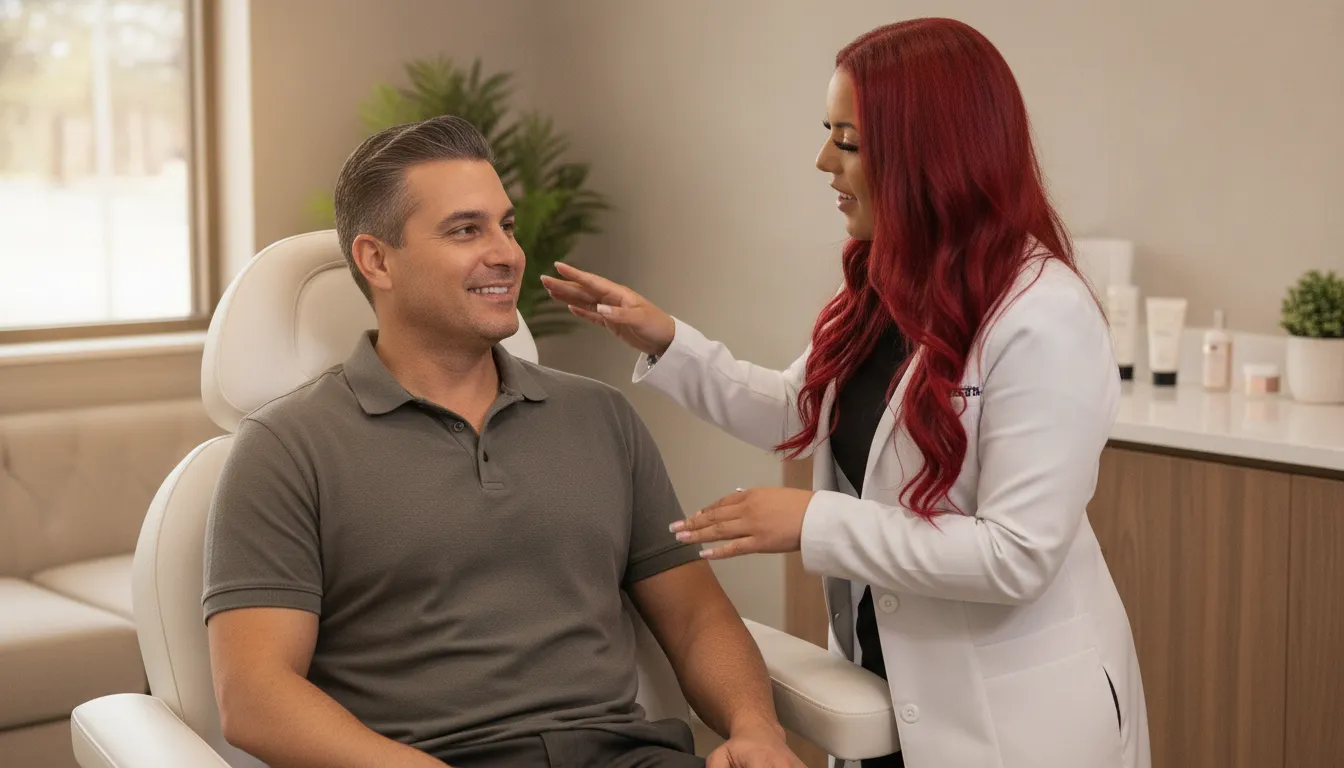
A polished appearance usually starts with a few consistent habits, not a crowded bathroom shelf. Cleansing after exercise, moisturizing while skin is still slightly damp, protecting exposed skin from the sun. And shaving with less friction can support comfort and a more even-looking complexion. Persistent irritation, acne, uneven texture, hair loss, or established lines may call for a more individualized conversation rather than another random product.
Contact Soul Glow Medspa to discuss personalized care.
A practical men’s skincare plan usually includes a mild cleanser, a moisturizer suited to your skin type, and broad-spectrum SPF 30 or higher. Professional facials, targeted skin treatments, injectables, or hair restoration may complement home care when goals, candidacy, and expected results are reviewed with a qualified provider. Results may vary.
The foundation is simple: understand what your skin is doing, then choose steps you can follow consistently. The next section breaks that foundation into a manageable morning and evening routine.
What Does a Simple Men’s Skincare Routine Include?
A consistent routine does not need to be complicated. The most useful men’s skincare plan covers cleansing, moisture, sun protection, and a few adjustments for exercise or shaving. Start with the basics, then give your skin time to show you what it tolerates well.
- Cleanse gently in the morning. Wash your face with a mild facial cleanser and lukewarm water rather than hot water. The American Academy of Dermatology recommends washing daily and after exercise. A gentle cleanser can remove sweat and surface buildup without the drying effect that some regular bar soaps may cause. If you train during the day, wash your face afterward instead of allowing sweat to sit on the skin for hours.
- Moisturize while skin is still slightly damp. Apply a daily moisturizer after cleansing, showering, or shaving while the skin retains some moisture. Moisturizer helps trap water in the skin and may reduce the appearance of fine lines. Choose a texture that feels comfortable enough to use consistently. If a product stings, burns, or leaves persistent irritation, stop using it and ask a qualified professional for guidance.
- Protect your skin with broad-spectrum SPF. In the morning, apply a broad-spectrum, water-resistant sunscreen with SPF 30 or higher. Mayo Clinic guidance describes a palm-sized amount as a useful application reference. Reapply every two hours, or more often after swimming or sweating. This step matters even when your main goal is maintaining an even-looking complexion, since cumulative sun exposure contributes to wrinkles, age spots, and other skin problems.
- Make shaving part of your skin plan. Shaving can be one of the most irritating parts of a routine, especially when the skin is already dry or reactive. Keep the process gentle, avoid aggressive scrubbing, and moisturize afterward while the skin is damp. If your face feels unusually irritated after shaving, simplify the rest of the routine rather than adding several new products at once.
- Keep the evening routine simple. Cleanse away the day’s sweat, sunscreen, and surface residue, then moisturize again if your skin feels dry or tight. You do not need a long list of steps to build a useful foundation. Consistency makes it easier to identify which products support your skin and which ones cause discomfort.
Home care is a starting point, not a substitute for medical evaluation when irritation or another concern persists. Results may vary, and a qualified provider can help you choose an appropriate next step for your skin’s needs.
How Should Men Adjust Skincare for Their Skin Type and Concerns?
Skin type is a useful starting point, but it is not a diagnosis. Oily skin may look shiny or greasy, while dry skin can feel rough, itchy, or flaky. Combination skin may be oily in some areas and dry in others. If products regularly sting or burn, your skin may be sensitive, and a simpler routine may be more comfortable. The American Academy of Dermatology notes that identifying your skin type can help you choose products that suit you.
For acne-prone skin, look for cleansers and moisturizers labeled oil-free or non-comedogenic. These formulas are designed to be less likely to clog pores. Sensitive skin often responds better to mild, fragrance-free products. Read labels carefully: “unscented” does not always mean fragrance-free, because masking fragrances may still be present. Introduce one new product at a time so you can recognize irritation more easily.
Shaving can add another layer of discomfort, especially when you experience razor bumps, ingrown hairs, or razor burn. Wet your skin and facial hair first to soften them. Apply a moisturizing shaving cream, then shave in the direction of hair growth without stretching the skin taut. A single- or double-blade razor may be preferable if bumps are a recurring concern. Replacing the blade after five to seven shaves may also help minimize irritation. Persistent bumps, painful breakouts, or severe irritation deserve professional evaluation rather than repeated experimentation.
Sun exposure affects every skin type. Over time, ultraviolet exposure can contribute to wrinkles, age spots, other skin problems, and a higher risk of skin cancer. Use a broad-spectrum, water-resistant sunscreen with SPF 30 or higher. Apply a palm-sized amount to exposed areas and reapply about every two hours, or more often after swimming or sweating. Seeking shade, particularly between 10 a.m. and 4 p.m., adds another layer of protection. Smoking can also make skin look older and contribute to wrinkles.
These principles can help you build a practical routine, but ongoing acne, unusual changes, or irritation that does not settle may require individualized guidance. When home care is not addressing a concern, professional skin treatments may be considered after a careful assessment. Results may vary.
When Can Professional Facials and Skin Treatments Help?
A consistent home routine is the foundation of men’s skincare, but it may not address every concern. Professional care can be useful when you want more focused exfoliation, support for uneven texture, or guidance for a concern that has remained persistent despite sensible daily habits. The goal is not to replace cleansing, moisturizing, and sun protection. It is to match the right treatment to your skin, goals, tolerance for downtime, and clinical needs.
A facial may be an appropriate starting point for routine maintenance or a refreshed appearance. Soul Glow Medspa describes its facials as multi-step treatments that can include cleansing, exfoliation, steaming, extraction, and nourishment. Options may be tailored toward general skin health, hydration, acne-prone skin, or visible signs of aging. If you are unsure where to begin, explore these personalized facial options before choosing a more intensive service.
When a targeted treatment may make sense
Chemical peels can be customized by strength and purpose. Depending on the evaluation, they may be considered for uneven tone, texture, acne-related concerns, acne scars, signs of aging, or the appearance of sun damage. A lighter peel may provide gentle exfoliation with minimal downtime, but the appropriate choice depends on your skin and the provider’s assessment.
Microneedling with PRP is another treatment-led option. Soul Glow describes it as a way to support collagen and elastin production while addressing the appearance of texture, fine lines, acne scars, or hyperpigmentation. Redness and swelling may occur afterward and usually subside within a few days, although individual recovery differs. It should not be treated as a universal solution or selected without reviewing candidacy and aftercare.
RF skin tightening uses non-invasive radiofrequency energy with the intended purpose of supporting skin tightening and collagen production. Laser skin rejuvenation may be considered when sun damage, fine lines, or uneven tone are central concerns. These treatments have different indications, sensations, risks, and recovery considerations, so a consultation should guide the decision rather than a trend or a promise of a particular outcome.
Contact Soul Glow Medspa to discuss a personalized skin treatment plan.
Professional care is most helpful when it complements realistic home habits. A qualified provider can review your current products, skin history, active irritation, and goals before recommending a facial, peel, microneedling, RF, or laser service. Results may vary, and persistent acne, severe irritation, unusual lesions, or other medical concerns may require evaluation beyond a cosmetic treatment.
| Option | May fit goals such as | What to discuss |
|---|---|---|
| Facial | Routine cleansing, hydration, or a refreshed appearance | Skin type, active irritation, and desired level of exfoliation |
| Chemical peel | Uneven tone, texture, acne-related concerns, or sun damage | Peel strength, candidacy, aftercare, and downtime |
| Microneedling or PRP | Texture, fine lines, acne scars, or hyperpigmentation | Skin history, recovery, and the treatment plan |
| RF or laser care | Skin tightening, fine lines, or uneven tone | Indication, sensation, risks, and expectations |
Can Injectables Fit Into a Men’s Skincare Plan?
A consistent routine supports the skin’s surface, but it does not address every concern. Some men consider injectables when expression lines, changes in facial volume, or a less defined jawline remain noticeable despite good daily care. The goal should be a measured plan that respects your facial structure, preferences, and comfort level, not a generic treatment menu.
Neurotoxins such as Botox are designed to temporarily relax selected facial muscles. Soul Glow describes treatment areas that include forehead lines, crow’s feet, and frown lines between the brows. This makes them most relevant to dynamic wrinkles, which become more visible with repeated expressions. Results are temporary and may last up to three to four months, depending on the product, treatment area, and individual response. Explore injectable treatments to understand the options available.
What about volume and jawline goals?
Dermal fillers use hyaluronic acid, a substance naturally found in the skin, and may be considered when restoring lost volume or supporting soft-tissue definition is an appropriate goal. Commonly listed treatment areas include the cheeks, chin, jawline, lips, and nasolabial folds. A provider may discuss proportion and balance rather than simply adding volume. For some patients, Sculptra offers a different approach because poly-L-lactic acid is intended to stimulate the skin’s natural collagen production gradually over a series of treatments.
How is candidacy evaluated?
A consultation should come before a treatment decision. A qualified provider reviews your medical history, medications, skin and facial anatomy, goals, previous procedures, and tolerance for possible recovery. They should also explain the selected product, alternatives, limitations, and what results can reasonably be expected. Men who want a subtle change can say so directly. Clear communication helps the plan stay aligned with your features instead of chasing an artificial standard.
Injectables are optional complements to men’s skincare, not replacements for cleansing, moisturizing, sun protection, or evaluation of a persistent skin concern. Treatment choice, response, and duration vary from person to person. Results may vary, and your provider should answer questions about risks and aftercare before proceeding.
What About Hair Restoration and Scalp Care?
Facial skincare can improve cleansing, hydration, texture, and sun protection, but scalp and hair concerns often call for a separate conversation. Changes in density, shedding, hairline appearance, or scalp comfort may not be addressed by the same products you use on your face. A thoughtful evaluation can help distinguish a cosmetic concern from an issue that deserves medical attention, while keeping the plan focused on your goals.
Soul Glow Medspa includes PRFM hair restoration among its hair restoration offerings. PRFM, or platelet-rich fibrin matrix, uses a patient-derived material as part of a provider-guided approach to supporting the scalp and hair. It is not a substitute for a complete assessment. During an evaluation, a qualified provider can discuss your history, current concerns, scalp condition, treatment candidacy, and whether additional topical or nutritional protocols may be appropriate. The goal is a comprehensive plan rather than a one-size-fits-all procedure.
If hair loss is sudden, patchy, painful, or accompanied by significant scalp changes, ask about medical evaluation before choosing an aesthetic treatment. Persistent symptoms may have causes that require a different type of care. A discreet, informed consultation can also help set practical expectations about the number of visits, maintenance, possible downtime, and how progress will be assessed.
You can learn more about hair restoration options available through Soul Glow Medspa. Treatment selection and response vary from person to person, and results are not guaranteed. Results may vary.
How Do You Build a Routine You Will Actually Follow?
The most effective routine is one you can repeat consistently. Start with the smallest useful version: a mild cleanser, moisturizer, and broad-spectrum sunscreen. Once those steps feel automatic, introduce only one new product or active ingredient at a time. This makes it easier to understand what helps and what may be causing irritation.
Pay attention to how your skin responds rather than assuming more products will produce better results. Stinging, burning, unusual redness, worsening dryness, or persistent peeling are reasons to pause a new product and review the ingredient list. People with sensitive skin may benefit from mild, fragrance-free products, while those with acne-prone skin can look for oil-free or non-comedogenic cleansers and moisturizers. The American Academy of Dermatology notes that identifying your skin type can help you select products suited to your needs: learn more about men’s skincare basics.
Build the routine around habits you already have. Cleanse after exercise, moisturize while skin is still slightly damp after washing or shaving, and apply sunscreen before leaving home. The AAD recommends broad-spectrum, water-resistant sunscreen with SPF 30 or higher, with reapplication every two hours or sooner after swimming or sweating. Keeping products in one visible place and using simple reminders can also make follow-through easier.
Professional guidance is appropriate when irritation does not settle after stopping a product, acne remains persistent, or a new, unusual, painful, bleeding, or changing spot appears. A qualified provider can help distinguish a routine concern from one that needs medical evaluation and can recommend care that fits your skin, schedule, and goals. Results may vary, so bring a list or photograph of products you use when discussing ongoing concerns.
Frequently Asked Questions
Which skincare products are most important for men?
Start with a mild facial cleanser, a moisturizer suited to your skin type, and broad-spectrum sunscreen. The best choices depend on whether your skin is oily, dry, combination, acne-prone, or sensitive. For sensitive skin, fragrance-free products may be less irritating than fragranced formulas. The American Academy of Dermatology recommends broad-spectrum, water-resistant sunscreen with SPF 30 or higher, reapplied every two hours or after swimming or sweating: AAD guidance for men’s skincare.
What is a good daily skincare routine?
In the morning, cleanse gently, moisturize, and apply sunscreen. In the evening, cleanse again and moisturize. Wash after exercise, and give shaving its own attention by wetting the skin first, using moisturizing shaving cream, and shaving in the direction of hair growth. Introduce one new product at a time so you can identify irritation or sensitivity.
How can I manage razor bumps and irritation?
Do not stretch the skin taut while shaving, and consider a single- or double-blade razor if you frequently develop bumps, burns, or ingrown hairs. Replacing the blade after five to seven shaves may help minimize irritation, according to the American Academy of Dermatology. Persistent or severe irritation deserves professional evaluation rather than repeated product changes.
When should a man see a skincare professional?
Consider an evaluation when acne, discoloration, texture concerns, persistent irritation, visible sun damage, or hair loss does not improve with consistent home care. A qualified provider can review your goals and determine whether a facial, peel, laser treatment, microneedling, injectable, or hair restoration approach is appropriate. Candidacy, risks, downtime, and expected results should be discussed beforehand. Results may vary.
Ready to Personalize Your Men’s Skincare Plan?
A thoughtful routine can be a strong starting point, while professional guidance may help connect your goals with appropriate skincare or treatment options. Contact Soul Glow Medspa to discuss a personalized plan for your needs in Farmers Branch or North Dallas. Your provider can help you consider practical next steps and realistic expectations. Results may vary.
