
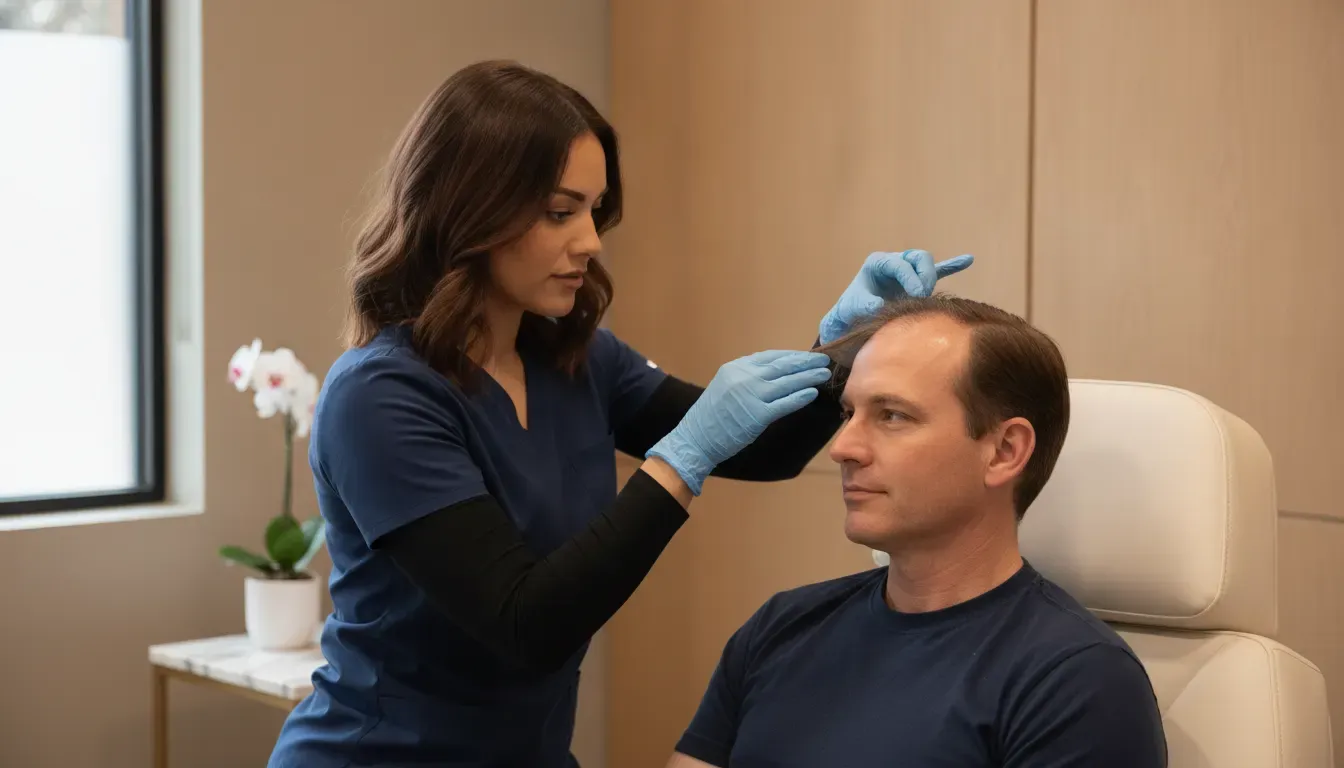
Noticing more hair in your brush or a widening part can raise practical and personal questions. Hair thinning is not one condition with one solution. It may develop gradually or appear suddenly, affect the hairline or the whole scalp. And have causes that range from heredity and aging to hormonal changes, medication, stress, or an underlying medical concern.
For people researching hair loss treatment Dallas patients can consider, the most useful first step is an informed assessment. The pattern and possible cause of loss help determine whether a regenerative treatment, scalp care, medical management, or referral for further evaluation makes sense. Soul Glow Medspa serves Farmers Branch and North Dallas with individualized hair-restoration planning in a private, welcoming setting.
Contact Soul Glow Medspa to discuss your hair-restoration questions.
This guide explains common causes, nonsurgical options, the difference between PRP and PRFM, and what to ask before choosing a plan. It also connects hair restoration with the broader Dallas wellness services approach at Soul Glow. Results may vary, and this educational information is not a diagnosis.
What Causes Hair Loss in Men and Women?
Hair loss has many possible explanations. Hereditary pattern loss and normal age-related changes are common. Hormonal shifts, recent illness, nutritional concerns, medications, physical or emotional stress, scalp inflammation, and other medical conditions can also affect the hair-growth cycle. A person may see recession at the forehead, thinning at the crown, a widening part, diffuse shedding, or a localized patch.
The pattern can provide useful context, but it does not establish a diagnosis. Sudden shedding, bald spots, scalp pain, persistent itching, redness, scaling, or rapidly worsening loss deserves medical evaluation. Loss that affects the eyebrows or beard should also be discussed with a qualified medical professional. The UT Southwestern hair-loss resource explains that scarring and non-scarring forms may require different approaches.
A thorough history and examination can clarify when the change began and what may be contributing to it. A clinician may review health history, recent stressors, medications, hormonal factors, nutrition, family history, and scalp findings. This is important because a regenerative service may not address every underlying cause. In some cases, identifying and treating the cause is the first priority.
A consultation at Soul Glow Medspa can help determine whether the concern is appropriate for the services offered and whether additional medical guidance is warranted. Patients should feel comfortable asking what the evaluation includes, how candidacy is determined, and when referral or primary-care follow-up is recommended.
What Non-Surgical Hair Restoration Options Are Available?
Hair-restoration planning may include one approach or a combination of options. The choice depends on the pattern of loss, scalp health, relevant medical factors, treatment goals, and the clinical assessment. No single modality is a universal answer, and a careful plan should separate established treatment goals from expectations that cannot be guaranteed.
| Option | What it involves | Important consideration |
|---|---|---|
| PRP | Platelet-rich plasma prepared from the patient’s own blood-derived components and used in scalp injections. | Candidacy and the proposed role should be reviewed after an assessment. Read about PRP hair restoration. |
| PRFM | A platelet-rich fibrin matrix approach that is distinct from liquid PRP. | Soul Glow uses the Selphyl system. Preparation and goals should be explained during consultation. |
| Scalp treatments | Options such as Keravive scalp treatments may support a broader scalp-care plan. | Scalp condition and treatment goals affect whether this approach fits the plan. |
| Red light therapy | A device-based option listed among Soul Glow’s hair-restoration modalities. | It may be considered alongside other care, not as a guaranteed solution. |
| Medical management | Clinician-guided management when appropriate for the suspected cause and health history. | Medication decisions require qualified medical guidance and individualized risk review. |
| Surgical restoration | Procedures such as follicular unit extraction require a separate surgical evaluation. | Surgical restoration is different from nonsurgical services and may involve another provider. |
Soul Glow’s hair restoration treatment options can be discussed as part of a personalized plan. The goal is to understand the likely cause, choose an appropriate pathway, and set a way to review progress. Results may vary.
How Does PRFM Hair Restoration Differ from PRP?
PRP and PRFM are both autologous approaches, meaning they use components collected from the patient’s own blood. They are not interchangeable names for the same preparation. PRP stands for platelet-rich plasma. The sample is processed to concentrate plasma and associated components before the preparation is used in scalp treatment.
PRFM stands for platelet-rich fibrin matrix. Soul Glow uses the Selphyl system for this approach. Its preparation is designed to create a fibrin matrix rather than a liquid plasma preparation, giving it a different physical format and technical process. The PRFM and Selphyl guide provides more detail about that treatment.
Why does preparation matter?
The distinction matters because preparation, handling, and treatment planning should match the patient’s goals and clinical situation. Neither option is a universal winner. The more appropriate choice depends on the pattern of thinning, scalp findings, medical history, baseline density, and expectations.
A consultation can compare PRP, PRFM, scalp treatments, red light therapy, medical management, or a combined plan. It can also identify when a concern should be evaluated outside an aesthetic setting. The National Center for Biotechnology Information overview of alopecia describes why evaluation and classification matter when planning care.
What Results Can You Expect from Hair Restoration Treatment?
Hair restoration is a process of planning and observation, not a guaranteed shortcut. The expected response varies with the cause and extent of loss, baseline density, the chosen modality, overall health, and individual response. A responsible provider should explain what the treatment is intended to address, what it cannot promise, and how progress will be reviewed.
Before choosing a treatment, ask how the practice will establish a baseline. Consistent photographs, a discussion of the areas of concern, and a clear description of treatment goals can make follow-up more useful. Progress should be judged in context rather than by a promise of a particular amount of regrowth.
At Soul Glow Medspa, options may include PRP scalp injections, PRFM, red light therapy, Keravive scalp treatments, and medical management when appropriate. The hair restoration service page outlines the practice’s available modalities. A plan may change if the clinical assessment changes, if the response is limited, or if another type of medical evaluation becomes more appropriate.
Ask Soul Glow Medspa about an individualized hair-restoration assessment.
Results may vary. When shedding is sudden, painful, inflamed, patchy, or rapidly worsening, seek medical evaluation rather than relying on an aesthetic consultation alone.
How Many Sessions Does Hair Restoration Take?
There is no responsible universal session count for every patient. The recommended sequence depends on the treatment selected, the suspected cause, the area being treated, baseline density, health factors, and response over time. A fixed promise made before an evaluation does not account for those differences.
- Clarify the pattern and possible cause. Discuss when shedding or thinning began, where it is occurring, and any relevant health, hormonal, family, medication, or lifestyle factors.
- Set a baseline and define goals. Review current density and areas of concern. Talk about what natural-looking improvement means to you and what limitations should be expected.
- Match the plan to your needs. Review whether PRP, PRFM, scalp care, red light therapy, medical management, referral, or a combination is appropriate.
- Review progress thoughtfully. Follow-up discussions help determine whether to continue, adjust, or reconsider the plan. The number and spacing of sessions should follow the assessment rather than a generic promise.
Ask about preparation, aftercare, possible downtime, follow-up, and how the practice will assess your response. Clear answers support an informed relationship and help you decide whether the recommended pathway fits your goals.
What personal factors should be part of the conversation?
Share relevant changes in your health, medications, supplements, nutrition, stress, sleep, and family history. Tell the provider when shedding began and whether it followed illness, pregnancy, weight change, a new medication, or a period of major stress. These details do not diagnose the cause. But they can help the care team decide whether a nonsurgical plan is reasonable or whether another medical evaluation should come first.
It is also useful to discuss your priorities. Some patients want to address early thinning, while others want support for a specific area or a plan that fits around work and family responsibilities. A thoughtful conversation should cover realistic goals, follow-up, and alternatives. You should never feel pressured to choose a procedure before you understand why it was recommended.
How Do You Choose a Hair Loss Treatment Provider in Dallas?
Choosing a provider for hair loss treatment in Dallas should begin with clinical judgment, not a single procedure or a promise of fast regrowth. Look for a practice that takes time to understand your pattern of loss, health history, goals, and expectations before recommending a plan.
Does the provider evaluate the cause before recommending treatment?
Ask what information the provider reviews and whether the scalp and hair pattern will be assessed. Sudden, patchy, painful, itchy, or rapidly worsening loss may require medical evaluation before a regenerative or aesthetic service is considered.
Who provides medical oversight?
Ask about the credentials and roles of the people involved in your care. Soul Glow Medspa identifies Dr. Ricardo Martinez as Medical Director. Ariadna Sanchez, ARNP, FNP-BC, is the board-certified Family Nurse Practitioner and master injector, and Jordan Busansky, RN, BSN, is Co-Founder and COO. The care team should be able to explain who evaluates candidacy, who provides treatment, how products are sourced, and who answers questions after treatment.
What should you ask about candidacy and follow-up?
Useful questions include: What may be contributing to my hair loss? Am I a candidate for PRP or PRFM? Would another evaluation be more appropriate? How will progress be assessed? What happens if my response is limited? Exact recommendations depend on the assessment, your health, and your goals.
Soul Glow serves patients in Farmers Branch and the wider North Dallas area. You can review the practice’s wellness services and hair-restoration options before discussing the next step. Results may vary, and this information does not diagnose hair loss.
What makes a treatment plan feel trustworthy?
A trustworthy plan is specific about what is known, what remains uncertain, and how the next decision will be made. The provider should explain the purpose of the recommended service, expected follow-up, possible limitations, and when to seek outside medical care. Ask who will be available for questions after treatment and how concerns will be documented.
Look for a practice that values informed relationships over a quick, one-size-fits-all recommendation. You should have time to ask questions, consider alternatives, and decide whether the plan fits your needs. Hair restoration is personal, so privacy, clear communication, and realistic expectations are meaningful parts of the experience.
Frequently Asked Questions
What causes hair loss, and when should I seek an evaluation?
Hair loss may relate to heredity, hormonal changes, medical conditions, aging, stress, medications, or scalp concerns. Sudden, patchy, painful, itchy, persistent, or rapidly worsening loss deserves medical evaluation before treatment selection. A history and focused examination can help clarify possible causes.
Is PRFM better than PRP for hair restoration?
Neither option is universally better. PRP uses platelet-rich plasma from your own blood, while PRFM uses the Selphyl system to create a distinct platelet-rich fibrin matrix preparation. The appropriate option depends on your pattern of thinning, goals, medical history, and clinical assessment.
Who may be a candidate for nonsurgical hair restoration?
Adults with concerns such as gradual thinning may want to explore regenerative or nonsurgical care. Candidacy cannot be determined from photos or a search query alone. The evaluation should consider the cause and pattern of loss, scalp health, goals, and relevant medical factors.
How many sessions will I need?
Session needs and timing vary by the treatment selected, the cause and extent of thinning, and your response to care. Soul Glow does not promise a fixed number of sessions or a guaranteed outcome. Your plan should explain the recommended sequence, follow-up, and realistic expectations.
What Is the Next Step for Hair Loss Treatment Dallas Patients?
If you are researching hair loss treatment Dallas patients may access, begin with an assessment that respects both the medical context and your personal goals. A conversation can help clarify which options may fit your pattern, whether further evaluation is needed, and what realistic follow-up could look like. Soul Glow Medspa provides hair-restoration planning in Farmers Branch for patients from North Dallas. Results may vary, and an assessment does not replace care from your primary medical provider when symptoms are sudden or concerning.
Contact Soul Glow Medspa to explore your next step.
